

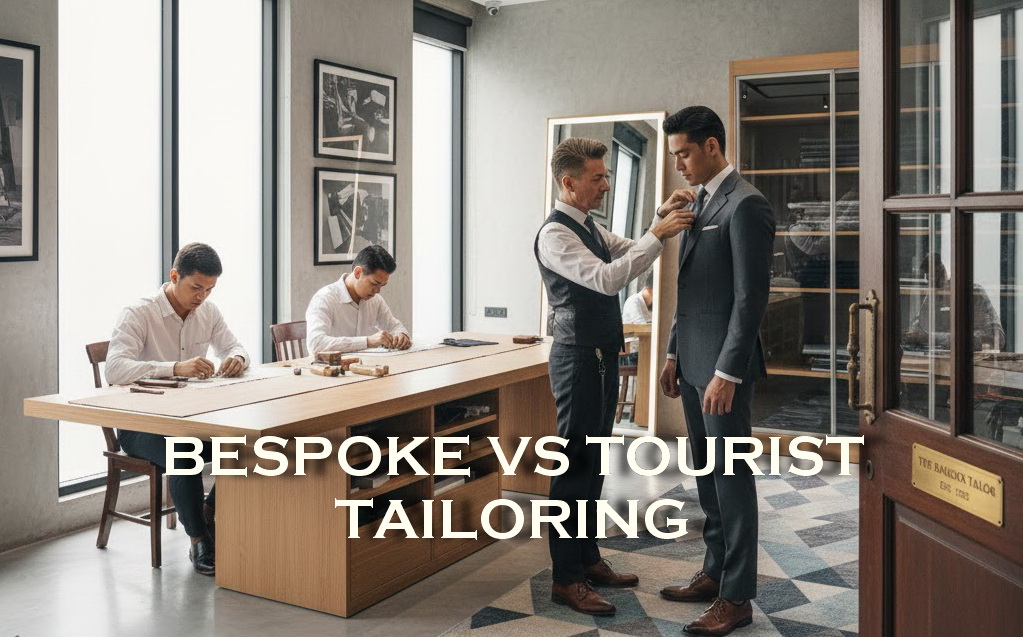
Tailoring marketing claims are useful only when they lead to details that can be checked. Words such as “premium,” “bespoke,” “hand-finished,” or “perfect fit” may describe an intention, but none proves fabric composition, construction quality, or the final result by itself.
A reliable approach translates each claim into evidence: a labeled cloth reference, an explained pattern method, fitting notes, agreed specifications, or a visible finishing detail. This keeps the discussion factual.
Why Tailoring Claims Need Context
Tailoring language often compresses several decisions into one phrase. “Custom” may refer to anything from adjusted standard measurements to an individually developed pattern. “Hand-finished” might describe a few operations rather than the entire garment. The term is a starting point for clarification, not a verdict.
Context should answer three questions: What part of the garment does the claim cover? What process supports it? What record or physical detail can confirm it? Clear answers help readers understand an offer without ranking tailors.
What Evidence Can Support a Fabric Claim?
A useful fabric description identifies fiber composition, mill or merchant reference when available, weight or seasonal purpose, and the exact cloth selected. A swatch should match the material recorded for the order, while care expectations should suit the stated blend.
Labeling rules vary by market, but specific disclosure remains a useful principle. The FTC guidance on textile and wool labeling explains that covered products in the United States generally disclose fiber content, country of origin, and the responsible manufacturer or marketer. It does not certify craftsmanship, but it shows why a precise material description is stronger than an unsupported claim.

What Can Process Claims Actually Demonstrate?
Measurements and Pattern Decisions
A measurement list records dimensions, but it does not explain how posture, balance, shoulder position, or asymmetry will be handled. Useful evidence connects measurements to pattern decisions and identifies proportions that may require refinement.
Fittings and Alteration Records
The number of fittings alone is not a quality score. What matters is whether each fitting has a purpose and observations lead to controlled changes. Notes about collar position, sleeve pitch, trouser balance, or jacket length show how the garment is evaluated rather than merely tried on.

Construction and Finishing Details
Construction terms should identify the area being discussed. Canvas structure, seam allowance, buttonholes, lining attachment, pressing, and edge finishing are different subjects. A clear explanation states what is included and which details can be inspected on the finished garment.
Which Claims Deserve Follow-Up Questions?
Broad promises deserve specific questions. If a garment is called “fully bespoke,” ask how the pattern is created and retained. If a cloth is described as premium, ask for its composition and reference. If fit is guaranteed, clarify the fitting stages, alteration policy, and point at which the garment is complete.
A Neutral Evidence Checklist
- The material description identifies the selected cloth.
- Process terms relate to this garment, not just a slogan.
- Measurements connect to pattern or balance decisions.
- Fitting observations and alterations are recorded clearly.
- Construction, finishing, timing, and responsibilities are defined.
This checklist evaluates the clarity of a claim, not a business’s reputation. Evidence can reduce ambiguity, but it cannot predict every aspect of comfort, durability, or personal satisfaction.

What a Claim Cannot Guarantee
No label can guarantee that a garment will suit a particular body, occasion, or preference. Fabric pedigree does not replace good cutting; multiple fittings do not help if observations are ignored; handwork is not automatically appropriate in every area. Quality comes from compatible choices executed consistently.
Objective details and preference also differ. Lapel width, jacket length, softness, structure, and silhouette can be documented, yet the right choice still depends on the wearer’s needs. A credible explanation does not present taste as proof.
Use Claims as Questions, Not Verdicts
The goal is not to distrust every tailoring term. Ask what it means for the cloth, pattern, fittings, construction, and service being discussed. Specific answers create a useful record; vague repetition does not.
Once the language is clear, readers who want to see how these stages connect can review a complete custom tailoring process from consultation through fitting and finishing. The claim opens the conversation; the evidence explains what will be delivered.