

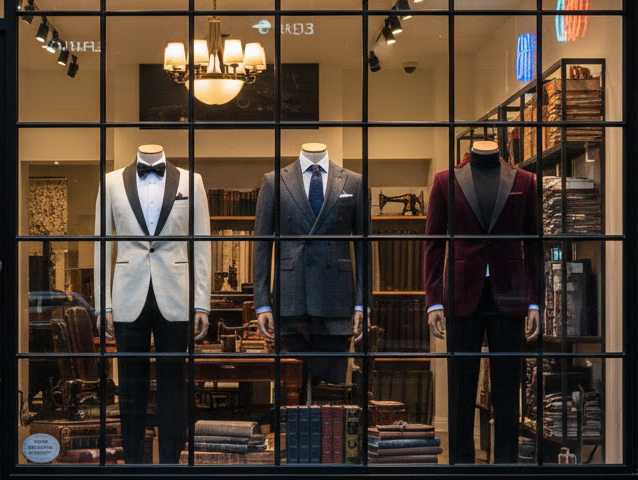
Suit priorities by occasion should change before fabric or styling enters the discussion. Business wear must support repeated professional use. Wedding attire adds ceremony coordination and photographic balance. Formal eventwear begins with the dress code. Similar details may appear, but their priority changes.
Start With the Job the Suit Must Do
Define the setting, frequency, formality, climate, and coordination needs. These factors separate a requirement from a detail that is merely attractive. A distinctive cloth may suit one evening but limit an office rotation; conservative navy can serve business yet need more texture for a wedding.
Business Suits: Repeatability and Professional Restraint
Business clothing is judged across meetings, travel, and professional dinners. The priority is a composed silhouette and cloth that coordinates easily. Navy, charcoal, and restrained patterns let shirts, ties, and shoes change without forcing the suit into one role.
Choose a Repeat-Wear System
Cloth should recover after wear, proportions should remain useful, and construction details should support regular use. A useful brief states frequency, climate, workplace expectations, and existing wardrobe pieces rather than requesting only a “corporate” look.
Wedding Suits: Coordination and Photographic Balance
A wedding suit must relate to the venue, time, ceremony tone, partner’s attire, wedding party, and accessories. It also needs definition in photographs without appearing theatrical in person.
Test Decisions Against the Whole Event
Review color beside the event palette. Check the jacket buttoned, seated, and in motion. Consider the complete outfit so one detail does not dominate. This is a coordination test—not a timeline guide or another suit-versus-tuxedo comparison.
Formal Events: Dress-Code Accuracy Before Individuality
Formal invitations create firmer boundaries. “Black tie,” “black tie optional,” and “formal” are not interchangeable. The Emily Post attire guide to dress codes places black tie above business attire in formality and identifies the tuxedo as the conventional men’s option. Set that context before personal styling begins.
Let the Invitation Set the Boundary
Within the correct formality, individuality can come from controlled choices such as lapel shape, shirt texture, waist covering, subtle cloth depth, or an appropriate dinner jacket. The goal is distinction within the code, not replacing the code with preference.
Compare the Three Priorities Side by Side
For business, ask whether the suit can repeat and coordinate. For weddings, ask whether it supports the event palette, photographs, and movement. For formal occasions, confirm that every major element respects the invitation before adding character.
Do not treat versatility, ceremony impact, and dress-code compliance as equal goals. One should lead; the others should support it.
What Can Stay Consistent Across Occasions?
Good balance, comfortable movement, appropriate cloth, and clear specifications matter everywhere. The wearer should explain preferences about softness, structure, trouser rise, jacket length, and ease. What changes is which requirement wins when trade-offs appear.
Frequently Asked Questions
Can one dark suit cover all three occasions?
Often—if the dress codes allow it. A restrained dark suit can cover business and many weddings, but it does not replace a tuxedo when black tie is required.
Should a wedding suit be more formal than a business suit?
Not automatically. Venue, time, and stated formality matter more than the word “wedding,” though coordination and photographs add priorities.
When does a formal event require a tuxedo?
Follow the invitation. Black tie conventionally calls for a tuxedo; black tie optional also permits a suitably formal dark suit.
How should climate affect occasion planning?
Climate affects cloth, lining, and comfort, but not the dress code. Adjust construction while preserving the required formality.
Which details should remain conservative?
Business suits favor restraint. At weddings or formal events, keep the garment controlled when accessories already provide contrast.
What information belongs in a tailoring brief?
Record the occasion, venue, dress code, frequency of wear, climate, coordination needs, preferred silhouette, and complete outfit.
Turn Occasion Priorities Into a Clear Brief
Begin with: “This garment must work for…” Add the dress code, setting, frequency, climate, coordination needs, and preferred impression. Rank them before styling.
Readers ready to translate that brief into tailoring a garment around its real purpose can then discuss cloth, proportions, fittings, and finishing from a shared reference point. The occasion defines the priority; the process turns it into a coherent garment.