

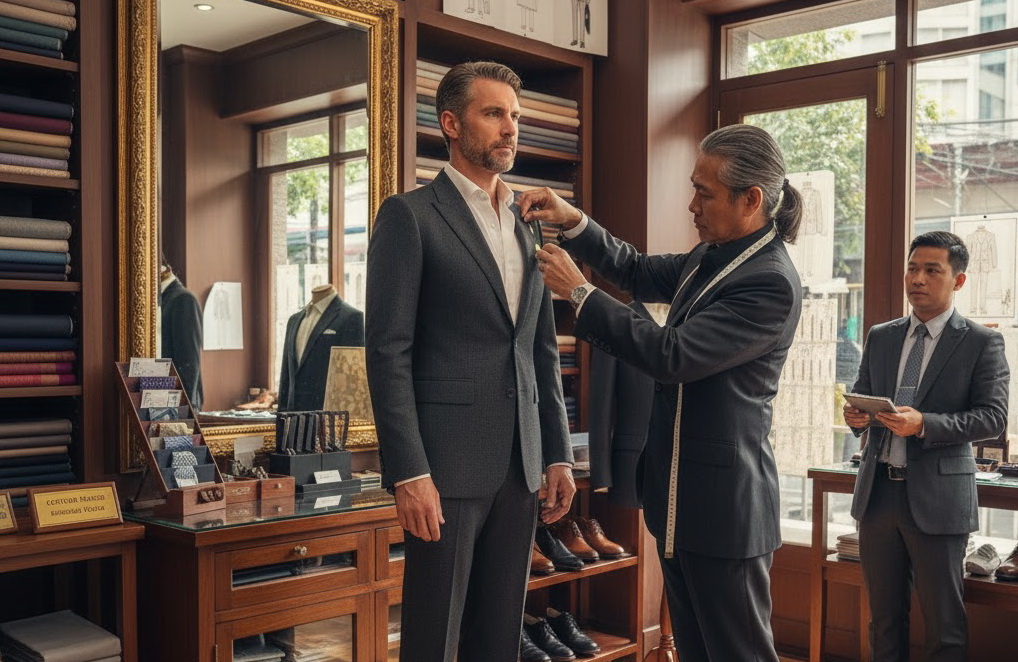
Executive meeting formality should be calibrated to the people, decision, venue, and consequences involved—not to a fixed idea of “power dressing.” Start with the most formal expectation in the room, then decide whether to match it, soften it, or add distinction through one controlled detail. The objective is to make the clothing support authority and clarity without becoming the subject of the meeting.
This is not a wardrobe audit, a networking-event guide, or a claim that a suit creates leadership. It is a decision matrix for choosing how formal a tailored outfit should be in a specific executive interaction.
Begin With the Decision at Stake
A routine internal review and a board presentation may occur in the same office but carry different consequences. Write down what the meeting must achieve: exchange information, obtain approval, negotiate terms, resolve a problem, or represent the organisation. Higher consequence calls for a more stable visual baseline.
Map the People in the Room
List the most senior participant, the client or regulator if present, and anyone whose expectations are not yet known. Formality is relational. Dressing several levels above a familiar internal team can create distance, while dressing below an external decision-maker can appear inattentive. When expectations conflict, follow the institution setting the boundary.
Separate Institutional Formality From Personal Style
Banks, law firms, creative companies, public agencies, and technology teams may read the same garment differently. Observe the institution before expressing individuality. Personal style can remain visible after that baseline is respected.
The Brown University discussion of executive presence treats appearance as only one part of a wider combination that includes communication and credibility. Clothing should therefore reinforce the message, not substitute for preparation.
Use a Three-Level Formality Matrix
Define three practical levels for your own work. Level 1 may be polished internal business wear. Level 2 may be a structured client or leadership meeting. Level 3 may be a board, investor, regulatory, ceremonial, or high-stakes negotiation setting. Use repeatable criteria for moving between them.
Control Contrast Before Adding Detail
Greater contrast between jacket, shirt, tie, and accessories increases visual emphasis. For a high-stakes room, controlled contrast often keeps attention on the speaker’s face and words. A lower-risk internal setting may allow softer combinations or an open collar.
Choose Structure for the Communication Task
A clearer shoulder and cleaner front can project definition; a softer construction can appear more accessible. Neither is universally superior. Match the silhouette to the task. A difficult negotiation may benefit from calm structure, while a collaborative workshop may call for less visual distance. Movement must remain unrestricted.
Account for Camera, Travel, and Climate
Video calls compress texture and can exaggerate high contrast. Travel adds sitting, packing, and recovery demands. Moving between heat and air conditioning changes comfort throughout the day. Test the outfit under the conditions that will actually occur rather than judging it only while standing in a quiet room.
Set One Deliberate Point of Distinction
Distinction is easier to control when it has one source: an excellent fit, a quiet fabric texture, a precise tie, or a considered pocket square. Multiple signals compete with the meeting. Choose the element that supports recognition without overtaking the message.
Run a Pre-Meeting Friction Check
Sit, reach, button, unbutton, and place the items you will carry in their real pockets. Check collar contact, sleeve movement, trouser comfort, shoe condition, and whether any adjustment becomes distracting. Formality fails if the wearer must manage the garment.
Document the Rule for Repeat Situations
After the meeting, record what the room expected and whether the outfit supported the interaction. Note the formality level, weather, travel, camera use, and any discomfort. A short record turns one judgment into a reusable rule.
Convert the Matrix Into a Tailoring Brief
Bring the meeting categories, movement conditions, climate cycle, and preferred formality range into a consultation that maps clothing choices to real business contexts. Describe the situations before requesting specific solutions. This lets cloth, structure, and details be evaluated against an actual professional use case.
The final test is simple: the outfit should meet the room’s expectation, support the wearer’s movement, and leave the business message in the foreground.